Total Pageviews

Showing posts with label Holy Ghost. Show all posts

Sunday, 20 May 2018

A DEEP BREATH

Veni, creator Spiritus . . .

I have always had a special feeling for the third Person of the Trinity. Perhaps because I felt he was getting short shrift, always less talked about than the Father and the Son: it seemed unfair. Later, as I finally learnt more about the content of our faith, this feeling persisted, if only because I found him referred to as the loving relationship between the Father and the Son, and I could not figure out how a relationship could be a Person.

There are, of course, all sorts of mysteries surrounding him. For instance, both in the Gospels and in the Acts of the Apostles he is sometimes referred to as if he were a specific, almost physical and delimited object or motion. Yeshua breathed on them, and they received the Holy Spirit. Almost like your peace, which you can bestow upon a house but which you can take back if the house does not receive you decently.

In three languages he is the same. In Hebrew, ruach; in Greek, pneuma; in Latin, spiritus; and in each of those languages the word can have the same three meanings: breath, wind, or spirit. It/he is what animates matter: God made Adam of clay, then breathed life into him. It is he who hovered over the primeval waters of the planet, creating differentiated life.

And when the Son approaches his final trial, he promises his friends that he will send them a Defender, an Advocate, someone who will accompany them always and be on their side no matter what the big greebly world will do to them. He is the paraklètos, the one who is on your side. And since he is also God, how can he fail?

Then, when Yeshua has risen and spent some time with them and finally gone to his Father’s house, the pneuma comes to them in a huge way on the feast of Pentecost, seven weeks after Pesach. By this time the followers of Yeshua are many, and from many countries around the Mediterranean; a crowd of them has assembled somewhere, possibly for a liturgy; and suddenly there is a sound as of a mighty rushing wind and tongues of fire appear on everybody’s head (the origin by the way, of the bishop’s mitre). And, amazingly, each person hears the apostles’ sermon in his own language or dialect. The ruach is there in Person,  just as a fiery Cloud appeared in the Temple.

And what the ruach does is in this case fascinating. As a French commentator said, this is the opposite of the Tower of Babel. There, there was uniformity and an ambition to be divine; here there is diversity and a Divinity who comes down. And the lesson, said the Frenchwoman, is that the Spirit allows us to hear the Word each in our own way and still (in every sense) communicate. We do not have to be the same or even much alike. The Word of God comes to us. All we need to do is unlock the door, open our windows, and fling the shutters wide.


And when he comes in, he will not only defend us but teach us. Teach us to pray, teach us to get things right, teach us discernment, teach us how to live in such a way as to make a home for him in our hearts. Coming into us, he breathes, and we are clay receiving life. Awkwardly blindly, we start moving, like a golem or Frankenstein’s monster; gradually we are filled with more of that spiritus until at last we become fully human. Human, that is, in the way we were created and meant to be. He is creator spiritus: he (re-)creates us to be new beings. We leave the caterpillar’s husk behind, marvel at out new colours, and spread our wings.


Illustration: El Greco, "Pentecost" (Madrid)

Monday, 5 June 2017

FOR WHIT MONDAY


To be read aloud, with strong accents:


THE WORLD is charged with the grandeur of God.
  It will flame out, like shining from shook foil;
  It gathers to a greatness, like the ooze of oil
Crushed. Why do men then now not reck his rod?
Generations have trod, have trod, have trod;                                     
  And all is seared with trade; bleared, smeared with toil;
  And wears man’s smudge and shares man’s smell: the soil
Is bare now, nor can foot feel, being shod.

And for all this, nature is never spent;
  There lives the dearest freshness deep down things;       
And though the last lights off the black West went
  Oh, morning, at the brown brink eastward, springs—
Because the Holy Ghost over the bent
  World broods with warm breast and with ah! bright wings.


                                     Gerard Manley Hopkins, "God's Grandeur"


Monday, 26 May 2014

AT OUR TABLE?


John 14:23: Jesus answered and said to him, “Whoever loves me will keep my word, and my Father will love him, and we will come to him and make our dwelling with him."

     This is staggering. The Father, the Son and the Holy Spirit will come and live with you or me?  Is this even thinkable in any other religion? Is it ever thought about in Christianity? I've never heard it discussed. Extraordinary intimacy! The most ordinary believer can become Abraham, and more than Abraham: not only a 'friend of God', but (the) one God lives with. Not of any of the greatest patriarchs in the Old Testament was this said.
     What would it be like, to live with the Trinity? Quite literally, Heaven on earth. Thinking about it forces you to imagine Heaven, something we don't often do. In the old paintings of the Last Judgement, the painters clearly enjoyed portraying Hell a great deal more than Heaven: the latter is usually populated with rather po-faced saints standing in serried ranks with prayer-books or their official iconographic attributes in their hands, looking pious. But if you imagine it on earth, and you are old enough to resist the Big Rock Candy Mountain image, it can be easier.
     You begin with Clopas and his chum walking to Emmaus in the company of one-third of the Trinity and feeling their hearts burn within them -- burn with excitement, with brand-new understanding, and with joy. Now think of the rare moments you have felt the presence of the Holy Ghost (I make no apology for using the old term: not even my unconscious connects it with ghosts, and I dislike double disyllables.) He is the Comforter, the Helper, the Advocate, the one on, and by, your side. You may have felt his Presence during some particularly remarkable church service, or standing on a high hill surveying the "coloured counties" with the wind in your hair; at an important or emotional moment of private prayer; or bringing about a totally unexpected solution to a deeply painful situation. It's almost as if there is an extra lung breathing inside you. There is a sense of things falling into place and somehow becoming bigger. You instinctively give thanks.
     Praying "through" the Son and receiving gifts from the Spiritus Sanctus already happens on earth. What about the Father? He always seems more remote; and yet it is to him that the Son tells us to address the most famous and universal of prayers. He is the Creator of the Universe, yet we are encouraged to call him "abba" -- "baba", "papa", what small children call their father. I doubt if many of us do: the awe is too great. Yet perhaps we should: the Son said the disciples were no longer servants but sons.
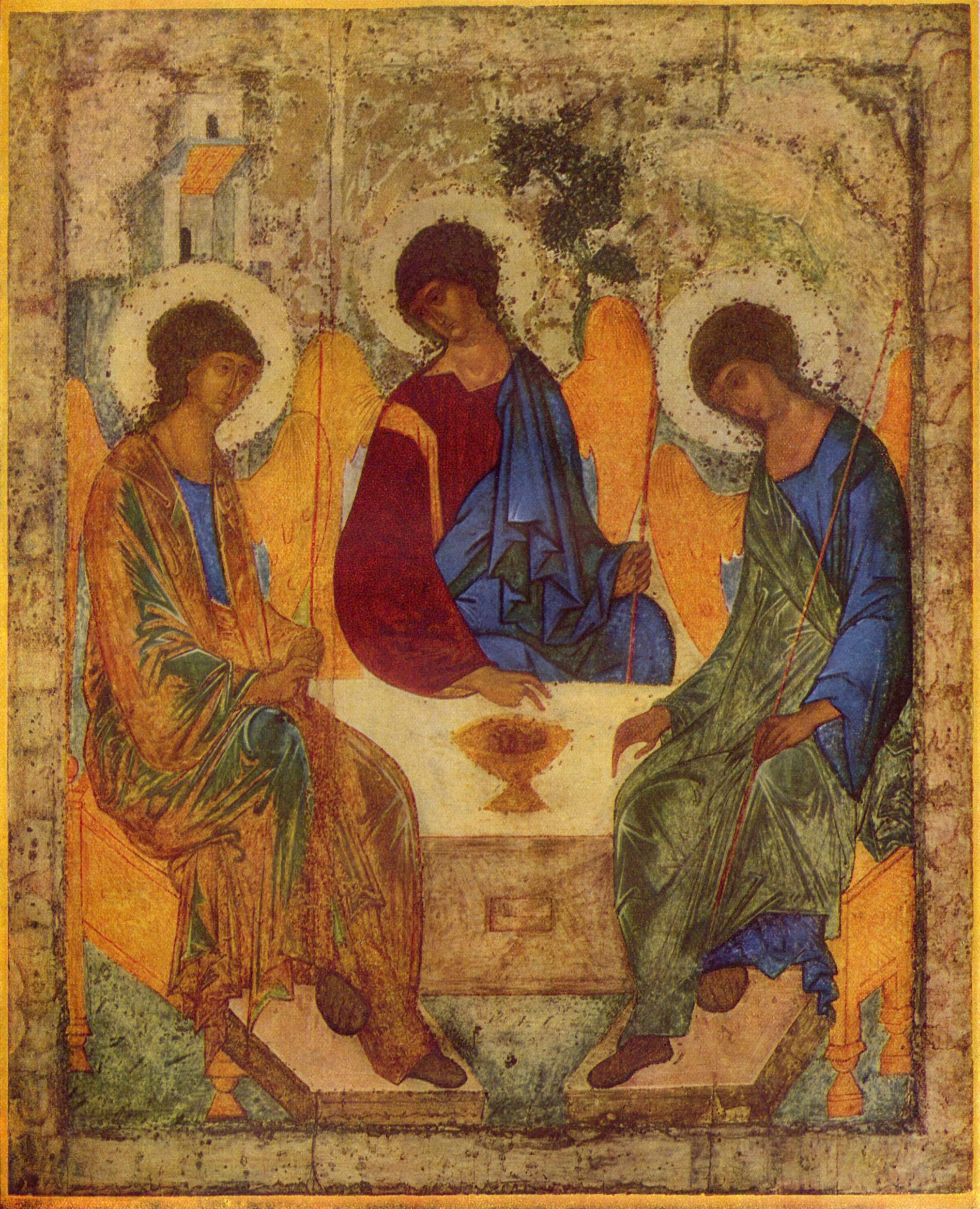
     Little by little, we are perhaps getting a sense of this Heaven on earth that loving the Son and doing what he tells us to do will bring about for us. It will have something of a family. There is a Father, our Father; his Son, and therefore our brother. Irving Layton, the Canadian Jewish poet and roisterer, once said to me "Roger, Jesus is my brother. I like him; I love him; but how can you call him God? My brother farts: does God fart?" "Yup," I said. I suspect that in that family we are invited to, there is Mother Mary as well. The Holy Ghost is probably sexless, though a person. He "proceeds from the Father and the Son", says the Creed. But he is not just the love between them: he is a fully-fledged Person of the Trinity. In the family, he might be She: if Jesus is our brother, the Hagion Pneuma might be our sister, though in a shadowy sort of way.
     How to convey such stupendous intimacy without sounding cosy and ridiculous? If we love him and keep his commandments, (T)HE(Y) will come "and make our dwellling" with us. I don't think this is intended to signify a reward, but rather a consequence. Such a way of life, if and when it becomes habitual, will bring it about completely naturally. If you put your hand in the fire, you will burn; if you jump off a building you will break your neck; if you sin against God's love, you will be miserable; if you love Him and keep His commandments, you will live as part of the family, in the family house. Heaven on earth. Shit may still happen, but Heaven on earth nevertheless.