Total Pageviews

Showing posts with label Son. Show all posts

Sunday, 27 May 2018

THE ATOM OF DIVINITY


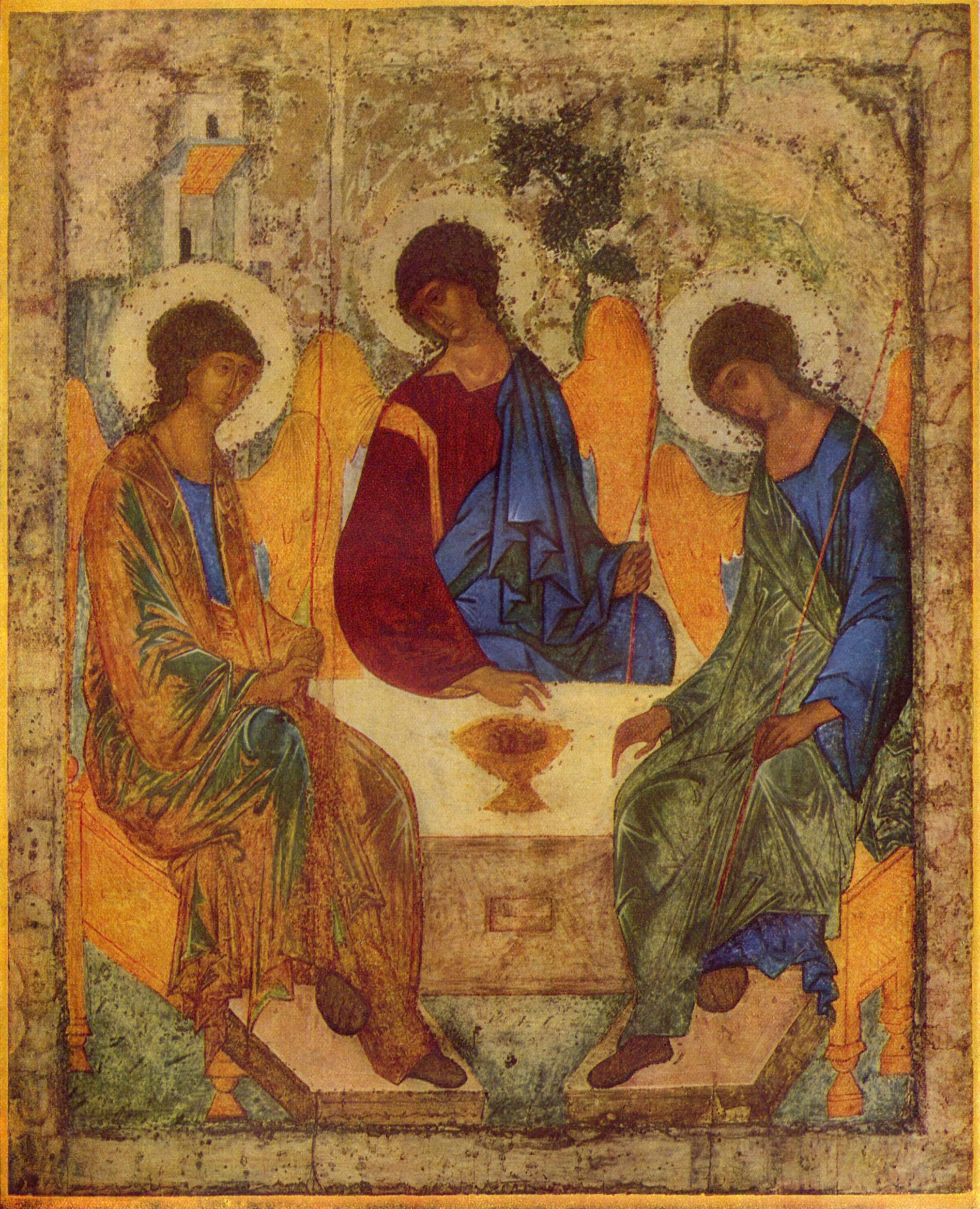
Andrei Rublev, icon of the Trinity (1425), Tretyakov Gallery, Moscow

I almost always celebrate Trinity Sunday by showing Andrei Rublev’s famous icon of the three Persons sitting round a table, because it is so hauntingly beautiful and also because it corrects one of modern theology’s common faults – a tendency to speak of the Spiritus Sanctus as the relation of love between the Father and the Son. A relation cannot be a person; not even a Person. (Socinius is dead.)

However, one should never simplify the Trinity: it is perhaps the faith’s greatest intellectual mystery. There is an admirable brief outline of its dogmatic history on the Christian History blog, yet it too discusses essentially the Father and the Son, and the relation between the two, but not the Holy Spirit. Let’s try and shed a little glim of light.

First: how can “God” be both One and Three? This is easier for us to understand than it was for our forefathers. We know that what appears like a stable molecule – and is a stable molecule – is also composed of a number of rapidly spinning atoms, and breaking those down reveals protons and electrons. I am not trying to establish an analogy here with the Trinity: merely suggesting that we understand better than previous ages how something can be simultaneously single and multiple.

Tertullian, the first great Church Father to work on the Trinity and defend it against the Arians, explains that when in working through a problem you discuss it with yourself, the ‘other voice’ in your mind is as it were a second person. It is a Logos; and if you are God, it is the Logos. And at some point that Logos may ‘proceed from’ the Father and take on its form as a second Person: the Son. Who is ‘begotten not made’ because no foreign substance is involved from which he would have been made.

The Spirit of God is there from the beginning: it is the Spirit that ‘brooded over the waters’. The Spirit, says one explanation, has a sovereign will comparable to the other Persons; he is free and not, to humans, predictable; he works on humans and creates, in them his own works – he creates, he guides, he strengthens, he advocates, he inspires, he teaches.

So today we celebrate the Ultimate Molecule, or Atom: the Holy Trinity. What holds it together is the Ultimate Energy: Love. This is one atom that cannot be split, though it can communicate its energy, and does so freely, generously and unendingly. We cannot even contemplate the Trinity without the concept of Love.

The Father, who created and creates the entire Universe; the Son, who is the Father’s Other-yet-not, and whose joy it is to do the Father’s will; the Son who came to us, who became for us fully human (Yeshua bar-Yosef of Nazareth with a saw in one hand and a scroll in the other) and died in order that we might be taken back into the divine relation of Love; and the Holy Spirit, the Comforter, the Strengthener, who remains with us always and is always as near as skin, always available, always ready to listen and to help.

What richness, what glory. Where else, said Moses to his people, can you find such a God?


Sunday, 11 June 2017

PATER, ET FILIUS, ET SPIRITUS SANCTUS. SICUT ERAT IN PRINCIPIO, ET NUNC ET SEMPER.


Andrei Rublev, "The Holy Trinity" (icon, 1400-1425).


The Trinity is a world, not of definition, but of prayer.

You can see how it began. In those years when Yeshua walked the earth, he tirelessly taught everyone who would listen about the Father. Our Father. Not just the Great God who made the universe; not just the jealous God who chided Israel; not just the just God who would one day judge the earth; but a God who was, is, and always will be our Father, our loving Father who may get justly irritated with his children but whose love for them will neither falter nor fail. He even taught us the words to address our Father.

But there was more. We are all the Father’s children, but as time went by and the Cross approached, Yeshua increasingly spoke about his own place in the scheme of things. Presumably trusting the disciples to be a little less thick now than they had been before, he began to tell them, in more than just parables, about the place of the Son in relation to the Father. Not just a pretty face; not just a guy. Not just a man. “He who has seen me has seen the Father.” Whoa! “All that is the Father’s is the Son’s; and all that is the Son’s is the Father’s.” “You will see the Son of Man [a term from Ezekiel] coming in clouds of glory.”

And then, when he came back to visit them in their loneliness, after the Resurrection when at first they often didn’t recognise him, he spoke of someone else still. “If I don’t leave you, the Comforter cannot come to you.” “I will send you an Advocate.” And he breathed on them, and they received the Spirit – the ruach, the pneuma, the very breath, wind, or spirit that after the Creation brooded over the waters like a gigantic bird. The heilige Geist in German, the Holy Ghost in the original Germanic English, now fallen out of use.

And so, when he had left finally to go back to his (and our) Father, and when the Geist had come upon the motley crowd of Pentecost – the Spirit taking up residence, as it were, in the ecclesia, in the Church, the collective of Christians, and not just in some individuals – one can imagine them sitting around for a few hundred years trying to make sense of all this, even as they prayed. After all, they had to explain it to new converts and interested strangers who wandered in from, say, Hellenistic civilisation where there were lots of gods, and who might say, “Oh, so you have only three gods? Interesting!” No, no, no. Not three gods. One God. “Right,” would say a Jew coming by. “But then what is all this nonsense about three Persons? God is one Person, and one Person only.” No, no, no. Three Persons. Father, Son, and Holy Ghost. And even the most benevolent would end up saying How does this work?

When I first got to know the Book of Common Prayer, one text I shied away from was the Quicunque Vult, or Athanasian Creed. It always seemed cross and minatory, as well as interminable. Yet reading it again today, on Trinity Sunday, I realised that it is a desperate attempt to understand just that difficult concept, 500 years on. Of course, it also contains anathemas against those who do not believe these essentials to salvation, which were what used to put me off. But it is fascinating in its dogged pursuit of the inexplicable.

The Trinity is a world, not of definition, but of prayer. It is a world of meditation and contemplation. Quicunque, whoever, pursues it in that manner will find a huge glory opening, and welcoming. It is a circle, a dynamic circle, a vast and stately whirl of love. Of a love in relation to which the Universe as we are coming to know it is a mustard-seed.

And Trinity Sunday? My American study of the BCP Collects notes that Trinity Sunday is the border between the season of Christianity’s great Truths and the season of Christianity’s activity and duty in the world. From now on, the liturgical colour is green, as are the fields and the hills beyond my window. Ora et labora: pray and plough. 


And for those who want to be reminded of the hard-edged content of our faith, here is the (pseudo-) Athanasian Creed itself:

Whosoever will be saved, before all things it is necessary that he hold the catholic faith. Which faith except every one do keep whole and undefiled; without doubt he shall perish everlastingly. And the catholic faith is this: That we worship one God in Trinity, and Trinity in Unity; Neither confounding the Persons; nor dividing the Essence. For there is one Person of the Father; another of the Son; and another of the Holy Ghost. But the Godhead of the Father, of the Son, and of the Holy Ghost, is all one; the Glory equal, the Majesty coeternal. Such as the Father is; such is the Son; and such is the Holy Ghost. The Father uncreated; the Son uncreated; and the Holy Ghost uncreated. The Father unlimited; the Son unlimited; and the Holy Ghost unlimited. The Father eternal; the Son eternal; and the Holy Ghost eternal. And yet they are not three eternals; but one eternal. As also there are not three uncreated; nor three infinites, but one uncreated; and one infinite. So likewise the Father is Almighty; the Son Almighty; and the Holy Ghost Almighty. And yet they are not three Almighties; but one Almighty. So the Father is God; the Son is God; and the Holy Ghost is God. And yet they are not three Gods; but one God. So likewise the Father is Lord; the Son Lord; and the Holy Ghost Lord. And yet not three Lords; but one Lord. For like as we are compelled by the Christian verity; to acknowledge every Person by himself to be God and Lord; So are we forbidden by the catholic religion; to say, There are three Gods, or three Lords. The Father is made of none; neither created, nor begotten. The Son is of the Father alone; not made, nor created; but begotten. The Holy Ghost is of the Father and of the Son; neither made, nor created, nor begotten; but proceeding. So there is one Father, not three Fathers; one Son, not three Sons; one Holy Ghost, not three Holy Ghosts. And in this Trinity none is before, or after another; none is greater, or less than another. But the whole three Persons are coeternal, and coequal. So that in all things, as aforesaid; the Unity in Trinity, and the Trinity in Unity, is to be worshipped. He therefore that will be saved, let him thus think of the Trinity.

Furthermore, it is necessary to everlasting salvation; that he also believe faithfully the Incarnation of our Lord Jesus Christ. For the right Faith is, that we believe and confess; that our Lord Jesus Christ, the Son of God, is God and Man; God, of the Substance [Essence] of the Father; begotten before the worlds; and Man, of the Substance [Essence] of his Mother, born in the world. Perfect God; and perfect Man, of a reasonable soul and human flesh subsisting. Equal to the Father, as touching his Godhead; and inferior to the Father as touching his Manhood. Who although he is God and Man; yet he is not two, but one Christ. One; not by conversion of the Godhead into flesh; but by assumption of the Manhood into God. One altogether; not by confusion of Substance [Essence]; but by unity of Person. For as the reasonable soul and flesh is one man; so God and Man is one Christ; Who suffered for our salvation; descended into hell; rose again the third day from the dead. He ascended into heaven, he sitteth on the right hand of God the Father Almighty, from whence he will come to judge the living and the dead. At whose coming all men will rise again with their bodies; And shall give account for their own works. And they that have done good shall go into life everlasting; and they that have done evil, into everlasting fire. This is the catholic faith; which except a man believe truly and firmly, he cannot be saved.


Sunday, 31 May 2015

3-IN-ONE


Trinity Sunday is the culmination, in a sense, of the Church’s liturgical year. We move from Advent to Christmas, from Christmas to Epiphany, from Epiphany to Lent, from Lent to the Cross, from Good Friday to Easter, from Easter to Whitsun, from Whitsun to the Ascension, and from Ascension Day to Trinity. Then comes what once described as ‘the long green highway of the year’, the Sundays After Trinity with their noble and varied Collects. But what of Trinity itself?

For the human race, apparently mired in death, the Great Event is the Resurrection. But the Resurrection cannot be taken without the Cross; the two together are the great outpouring of the Son’s love for us; and the Son is not, cannot be, without the Father. “Do you not believe that I am in the Father and the Father in me? The words that I say to you I do not speak on my own authority; but the Father who dwells in me does his works.” (Jn 14:10) And beyond that, there is the Holy Spirit: “And I will pray the Father, and he will give you another Counselor, to be with you for ever, the Spirit of truth, whom the world cannot receive, because it neither sees him nor knows him; you know him, for he dwells with you, and will be in you.” (Jn 14:16-7)

And so, meditating, thinking and praying (and frequently quarrelling), the Church came eventually (381 AD) to the doctrine of the Trinity: the Triune God, one God, three Persons. The Resurrection is the Event; the Trinity is the great Mystery of the faith. In the view of St Basil, his brother Gregory of Nyssa and Gregory of Nazianzus, as Karen Armstrong explains in A History of God, “the Trinity only made sense as a mystical or spiritual experience . . . It was not a logical or intellectual formulation but an imaginative paradigm that confounded reason. Gregory of Nazianzus made this clear when he explained that contemplation of the Three in One induced a profound and overwhelming emotion that confounded thought and intellectual clarity. ‘No sooner do I conceive of the One than I am illumined by the splendor of the Three; no sooner do I distinguish Three than I am carried back into the One. When I think of any of the Three, I think of him as the whole, and my eyes are filled, and the greater part of what I am thinking escapes me.’”

And yet it is a mystery that Jesus lets us in on, lets us into: because the Spirit dwells with us and in us, and if the Spirit and the Son and the Father are one, we are taken up into that great beating cosmic heart of Love. How do we celebrate it? All (of the Faith) is always present, wrote T.S. Eliot; yet the point of the liturgical year is that we can concentrate on some individual aspects at any one time. When the parable of the Good Samaritan is read, we look on the people we pass in the street in a new way; in Lent, we give a different attention to those who suffer; and on Trinity Sunday we might usefully learn from the Carthusians and other contemplative orders to meditate on the mystery as Gregory did. The more so in that that same Mystery has chosen to dwell with and in us, poor clods that we are.


CONTRA SPINOZAM TRINITAS

 My God, I heard them say
Thy way of being was a Clock of clocks,
A self-perpetuate motion, and that Love
Was, to create by necessary law;
And they reproach’d for Paradox
My words that thou, perfect above,
Didst need no more;
Sure they are blind who do not see
Thy love in this, that being is a gift;
Who do not sense that we
And all the random forms of hill and drift
Are here by no necessity
But by thy lasting Courtesy:
So they forget thy Trinity.

    Out of thy joyous solitude
    And tender in omnipotence
    To shape a world and on it brood,
    Fashioning trees and men of sense;

    From archangelic psalmody
    Mankind having destruction drawn,
    To enter into agony
    And for their healing to be torn;

    And, resurrected, still to dwell,
    Informing our experience,
    Praying in us, Immanuel,
    Unravelling our impotence;

Such thy unnecessary love: can we do less,
Released from death,
Than savour each delight of breath,
Blessing Thy wilfulness?


RK


Wednesday, 18 June 2014

UNIMAGINABLE?

I was away in Germany on Trinity Sunday, so my (first) post  on this sublime mystery is a few days late. Last year, I simply reproduced Andrei Rublev's famous icon, made in the monastery of the Trinity and St Sergius between 1408 and 1425, and now preserved in Moscow's Tretiakov Gallery. This year, the admirable French daily La Croix published a very fine commented reproduction of it. I haven't been able to make the arrows work, but the explanation is quite clear.


The three persons are set in a circle (which I've added here), with the central person’s hand as the centre. The circle,  with neither beginning nor end, symbolises eternity and places the three persons within one and the same reality. Their faces are identical (identity of nature of the three Persons of the Trinity) but their clothes are different, though all contain the blue of divinity. The wings emphasise their spiritual nature.

The left-hand person signifies the Father: it is on him that the others’ regard is turned, and they bow to him (he is the origin and principle of all); the colour of his raiment is indeterminate for he is indescribable. Behind him, the house is Abraham's tent, and “the Father’s house”.

The central person is the Son: in the purple, gold-embroidered tunic of Christus Pantocrator, he bows his head as in the Crucifixion icons. He presides over the table, and his hand blesses the cup that contains a lamb’s head: the cup of the New Alliance. The tree behinid him is the Oak of Mamre and also prefigures the Cross.

The right-hand person symbolizes the Holy Spirit: dressed in green (colour of youth), for “he makes all things new”. Behind him, the rock symbolizes his role as Defender: “my rock and my fortress art Thou” (ps.18)

One thing to remember is that these three persons are also the three persons (men? angels?) who visit Abraham and Sarah at Mamre (Genesis 18) and are fed by them. Which brings us back to the extraordinary saying of Jesus that if we will keep his commandments, he and his Father (and, evidently, the Holy Spirit) will come and dwell with us. 

The Trinity is the deepest mystery of Christianity. As one commentator said, it is not just a theological or philosophical concept, but of perfect topicality in the world: I and You and the Holy Spirit that unites us in love, are called to be living icons of God's deepest nature. Vertiginous! 


Monday, 26 May 2014

AT OUR TABLE?


John 14:23: Jesus answered and said to him, “Whoever loves me will keep my word, and my Father will love him, and we will come to him and make our dwelling with him."

     This is staggering. The Father, the Son and the Holy Spirit will come and live with you or me?  Is this even thinkable in any other religion? Is it ever thought about in Christianity? I've never heard it discussed. Extraordinary intimacy! The most ordinary believer can become Abraham, and more than Abraham: not only a 'friend of God', but (the) one God lives with. Not of any of the greatest patriarchs in the Old Testament was this said.
     What would it be like, to live with the Trinity? Quite literally, Heaven on earth. Thinking about it forces you to imagine Heaven, something we don't often do. In the old paintings of the Last Judgement, the painters clearly enjoyed portraying Hell a great deal more than Heaven: the latter is usually populated with rather po-faced saints standing in serried ranks with prayer-books or their official iconographic attributes in their hands, looking pious. But if you imagine it on earth, and you are old enough to resist the Big Rock Candy Mountain image, it can be easier.
     You begin with Clopas and his chum walking to Emmaus in the company of one-third of the Trinity and feeling their hearts burn within them -- burn with excitement, with brand-new understanding, and with joy. Now think of the rare moments you have felt the presence of the Holy Ghost (I make no apology for using the old term: not even my unconscious connects it with ghosts, and I dislike double disyllables.) He is the Comforter, the Helper, the Advocate, the one on, and by, your side. You may have felt his Presence during some particularly remarkable church service, or standing on a high hill surveying the "coloured counties" with the wind in your hair; at an important or emotional moment of private prayer; or bringing about a totally unexpected solution to a deeply painful situation. It's almost as if there is an extra lung breathing inside you. There is a sense of things falling into place and somehow becoming bigger. You instinctively give thanks.
     Praying "through" the Son and receiving gifts from the Spiritus Sanctus already happens on earth. What about the Father? He always seems more remote; and yet it is to him that the Son tells us to address the most famous and universal of prayers. He is the Creator of the Universe, yet we are encouraged to call him "abba" -- "baba", "papa", what small children call their father. I doubt if many of us do: the awe is too great. Yet perhaps we should: the Son said the disciples were no longer servants but sons.
     Little by little, we are perhaps getting a sense of this Heaven on earth that loving the Son and doing what he tells us to do will bring about for us. It will have something of a family. There is a Father, our Father; his Son, and therefore our brother. Irving Layton, the Canadian Jewish poet and roisterer, once said to me "Roger, Jesus is my brother. I like him; I love him; but how can you call him God? My brother farts: does God fart?" "Yup," I said. I suspect that in that family we are invited to, there is Mother Mary as well. The Holy Ghost is probably sexless, though a person. He "proceeds from the Father and the Son", says the Creed. But he is not just the love between them: he is a fully-fledged Person of the Trinity. In the family, he might be She: if Jesus is our brother, the Hagion Pneuma might be our sister, though in a shadowy sort of way.
     How to convey such stupendous intimacy without sounding cosy and ridiculous? If we love him and keep his commandments, (T)HE(Y) will come "and make our dwellling" with us. I don't think this is intended to signify a reward, but rather a consequence. Such a way of life, if and when it becomes habitual, will bring it about completely naturally. If you put your hand in the fire, you will burn; if you jump off a building you will break your neck; if you sin against God's love, you will be miserable; if you love Him and keep His commandments, you will live as part of the family, in the family house. Heaven on earth. Shit may still happen, but Heaven on earth nevertheless.